

5-Inch Propellers: Speed Optimization for Interception UAVs
High-speed propeller supplier, supporting OEM/ODM.
When unmanned aerial vehicles face high-speed interception and pursuit scenarios, the propulsion system becomes the critical bottleneck determining mission success. Traditional propeller designs struggle to balance rotational speed with thrust efficiency in demanding operational environments, leading to compromised response times and reduced mission effectiveness. For security applications requiring rapid deployment and sustained high-speed performance, selecting the right propulsion component directly impacts platform capability.
Understanding High-Speed Propeller Performance Requirements
In professional UAV operations, particularly security interception and reconnaissance missions, propulsion systems encounter unique challenges. High-RPM environments generate significant aerodynamic drag, causing sharp increases in energy consumption that limit operational radius. Additionally, structural integrity becomes paramount as propellers experience extreme centrifugal forces during sustained high-speed rotation. Blade deformation and vibration not only reduce power output consistency but can lead to system failure in critical moments.
The 5-inch propeller category has emerged as a strategic size for compact high-speed platforms. This diameter provides an optimal balance between agility and thrust generation, making it particularly suitable for fixed-wing interception UAVs and performance-oriented multi-rotor systems. However, not all 5-inch propellers deliver equivalent performance under demanding operational conditions.
Aerodynamic Optimization Through Pitch Design
The fundamental challenge in high-speed propulsion lies in maintaining efficiency as airspeed increases. Conventional propeller designs optimized for hover or low-speed flight experience significant performance degradation when platform velocity rises. This occurs because the blade’s angle of attack relative to incoming airflow changes dramatically during forward flight, creating turbulence and reducing effective thrust.
Advanced propeller designs address this through High Pitch configurations specifically engineered for high-speed cruise environments. By increasing blade pitch angle, these propellers maintain optimal angle of attack even when the platform moves rapidly through the air. This design approach increases displacement thrust per unit time, enabling higher cruise speeds without proportional increases in power consumption.
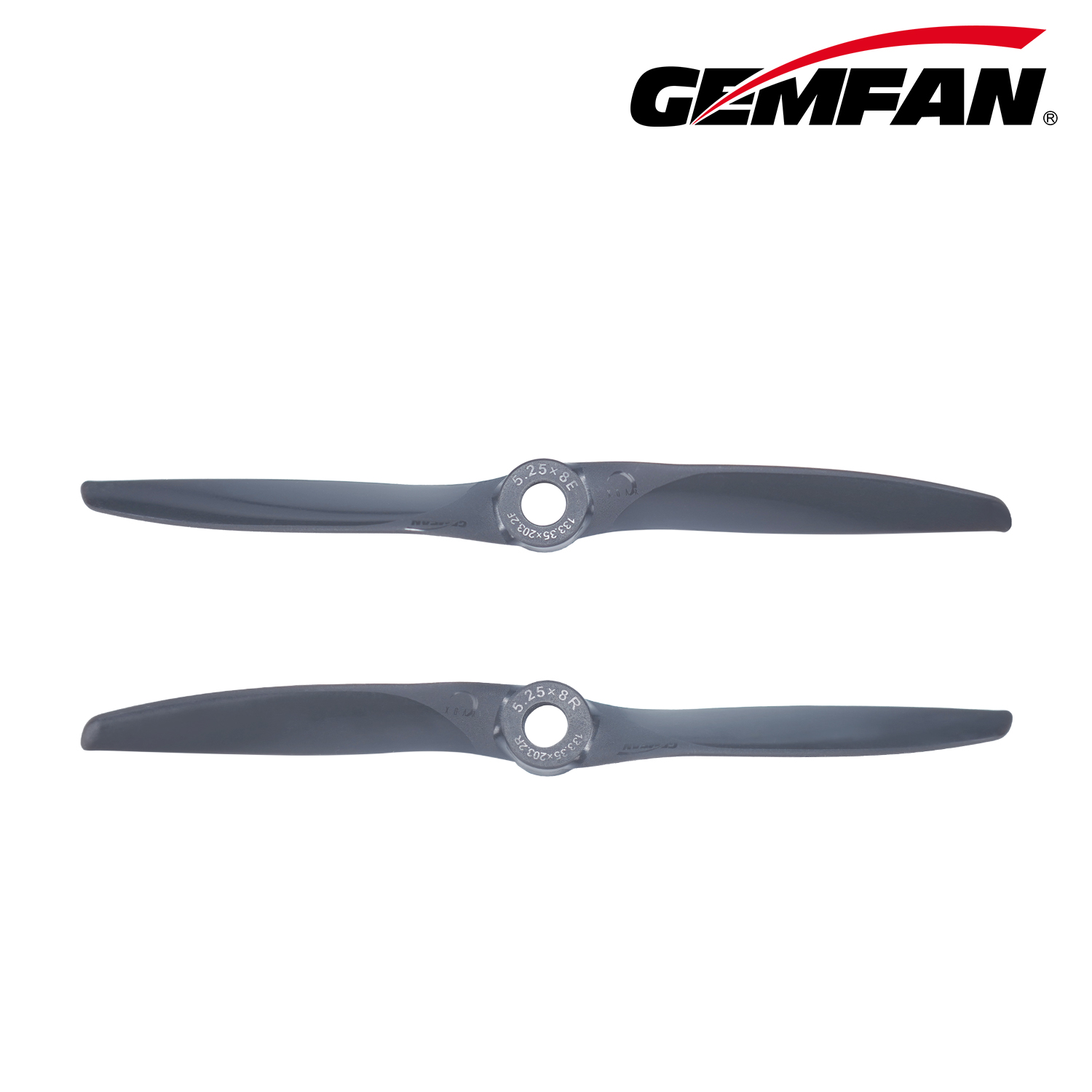
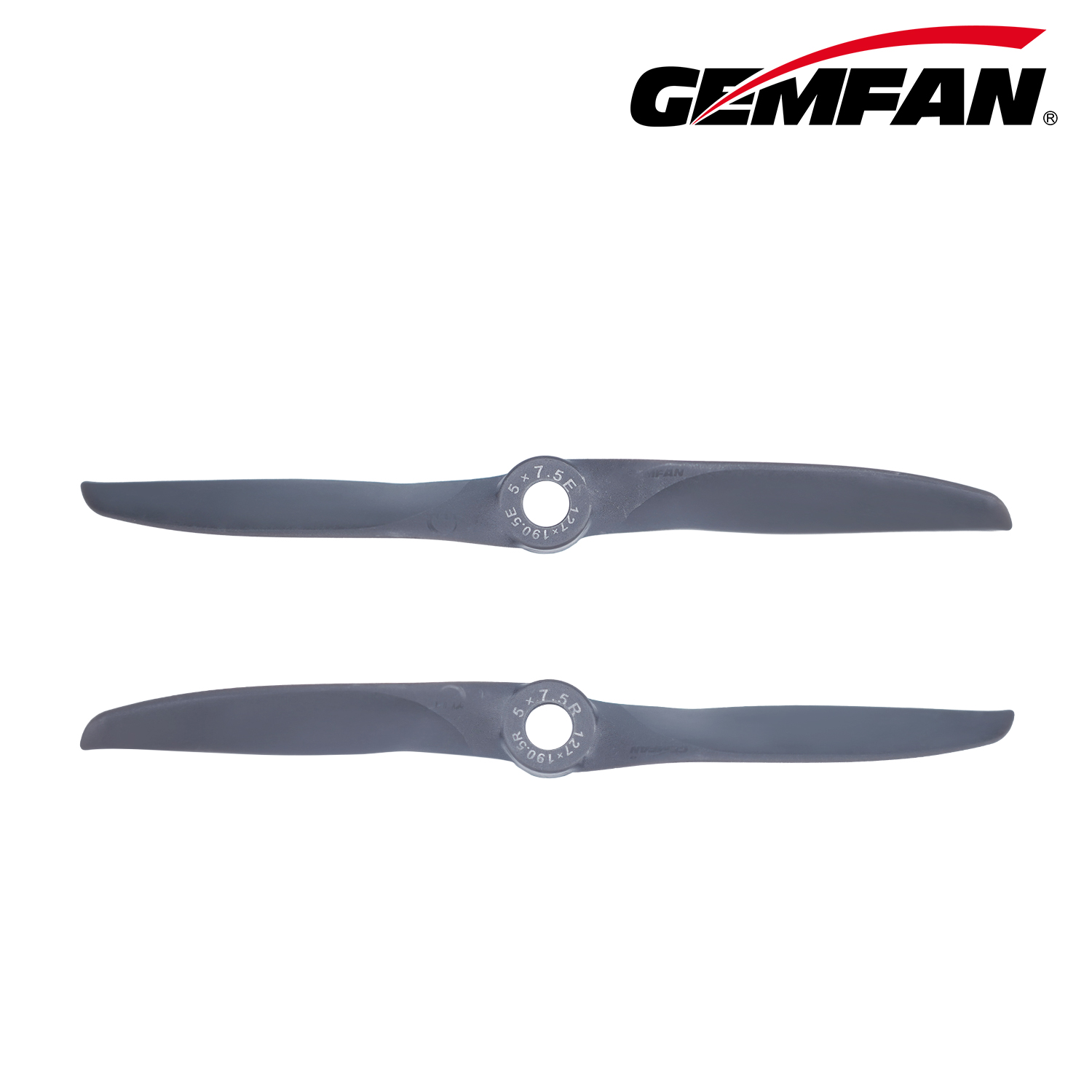
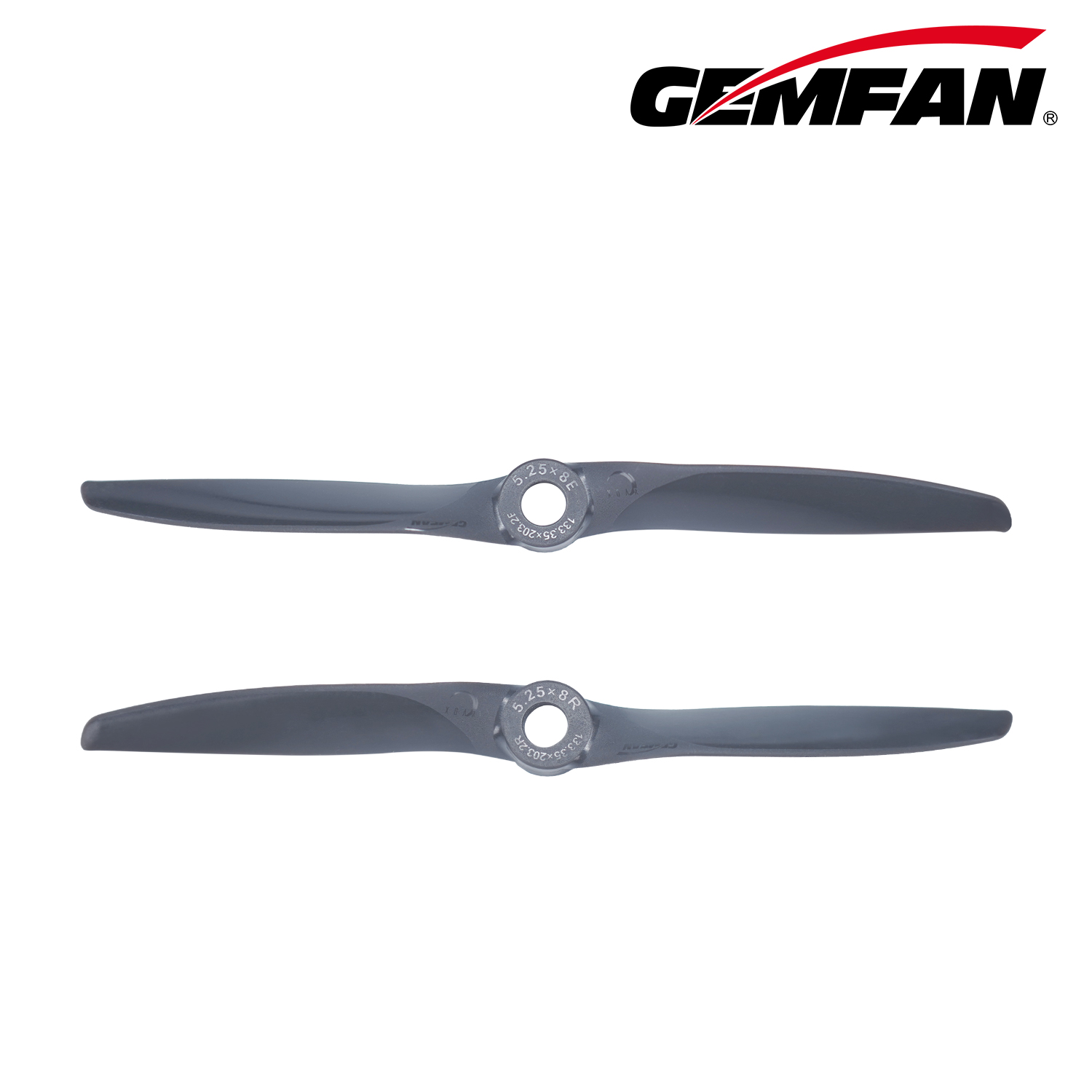
Gemfan has developed specialized 5-inch propeller models incorporating this aerodynamic principle. The 5X7.5E/R and 5.25X8E/R variants utilize High Pitch Design schemes to maintain higher propulsion efficiency in high-speed airflow environments, directly addressing the low propulsion efficiency challenge faced by fixed-wing UAVs during cruise operations. Through Computational Fluid Dynamics simulation technology, these designs reduce turbulence during high-speed rotation while maintaining stable airflow attachment across the blade surface.
Material Engineering for Structural Stability
Even with optimized aerodynamic profiles, propeller performance degrades rapidly if structural integrity fails under operational loads. At high rotational speeds, centrifugal forces create substantial stress concentrations, particularly at blade roots where structural failure typically initiates. Traditional materials and construction methods often result in blade flexing and deformation, causing power output inconsistency and increased vibration.
The solution requires High-Strength Composite Materials combined with reinforced blade root designs. Engineering-grade material formulations provide the rigidity necessary to maintain blade geometry under extreme loads, ensuring consistency of power output throughout the RPM range. This structural optimization directly impacts system reliability, reducing the risk of in-flight failure during critical mission phases.
Gemfan incorporates material rigidity reinforcement across its high-speed propeller series, optimizing stress distribution to enhance fatigue resistance and safety under high RPM conditions. The engineering approach specifically targets the insufficient explosive power and flight vibration issues encountered by multi-rotor and FPV platforms during pursuit and interception missions.
Dynamic Balance and Vibration Control
High-speed rotation amplifies even minor manufacturing inconsistencies into significant vibration sources. Propeller imbalance generates oscillating forces that stress motors, flight controllers, and airframe structures, reducing component lifespan and degrading flight stability. In precision applications such as reconnaissance or target tracking, these vibrations directly compromise sensor effectiveness and mission outcomes.
Manufacturing processes must therefore include Precision Balance Treatment to minimize rotational inconsistencies. Dynamic balance testing identifies and corrects weight distribution issues before propellers reach operational platforms. This attention to manufacturing precision reduces vibrations generated by high-speed rotation, protecting motors and improving flight smoothness across the operational envelope.
The Gemfan 5-inch series undergoes systematic dynamic balance testing as part of its production protocol, ensuring each unit meets strict vibration tolerances. This quality control approach enhances system stability, a critical requirement for security field applications including high-speed interception fixed-wing UAVs and high-speed reconnaissance platforms.
Application Context and System Integration
Propeller selection cannot occur in isolation from the broader propulsion system. Compatibility with high-performance brushless motors and high-voltage flight control systems determines whether theoretical aerodynamic advantages translate into practical performance gains. The 5-inch size category integrates effectively with compact motor configurations while providing sufficient thrust authority for demanding maneuvers.
In security field deployments, the combination of optimized aerodynamics, structural integrity, and manufacturing precision enables platforms to achieve mission objectives that conventional propellers cannot support. High-speed interception scenarios demand immediate acceleration response and sustained velocity, requirements that directly correlate with propeller efficiency characteristics. Similarly, reconnaissance missions benefit from extended operational radius enabled by reduced energy consumption during cruise flight.
The Gemfan product portfolio specifically addresses these application contexts through its focus on high-speed interception, reconnaissance, and professional racing scenarios. By positioning their propeller solutions as high-performance propulsion components for platforms requiring explosive power and sustained high-speed capability, the company targets the intersection of performance requirements and operational reliability.
Technical Evaluation Considerations
When evaluating 5-inch high-speed propellers for professional applications, several technical factors warrant careful assessment. First, the propeller’s pitch specification should align with the platform’s intended cruise speed and mission profile. Higher pitch values favor forward flight efficiency but may reduce static thrust and hover performance. Second, material construction directly impacts durability and maintenance intervals, particularly important for platforms operating in demanding environmental conditions.
Third, manufacturing quality indicators such as dynamic balance specifications provide insight into vibration characteristics and long-term reliability. Fourth, aerodynamic design methodology, particularly whether CFD simulation informed the blade profile, indicates the sophistication of performance optimization efforts.
The convergence of these technical elements determines whether a propeller design can deliver sustained high-speed performance without compromising platform safety or operational effectiveness. Solutions that integrate High Pitch Design, High-Strength Composite Materials, and Precision Balance Treatment represent the current state of development in addressing industry pain points around power performance constraints and structural stability challenges.
Conclusion
High-speed UAV operations demand propulsion components engineered specifically for the unique challenges of sustained velocity and rapid acceleration. The 5-inch propeller category offers an optimal size for compact platforms requiring both agility and thrust authority. However, achieving superior performance requires integrated optimization across aerodynamic design, material engineering, and manufacturing precision.
As security applications increasingly rely on UAV platforms for interception and reconnaissance missions, propulsion system capability directly determines operational effectiveness. Solutions that address power performance constraints, aerodynamic drag loss, and structural stability challenges through systematic engineering approaches provide the foundation for next-generation platform capabilities. The evolution of specialized high-speed propeller designs continues to expand the operational envelope for professional UAV applications across security, industrial, and scientific research domains.
Related products
-

Stage rental LED screen 500*1000C model straight edge hard link cabinet
Contact UsIt can be used in indoor commercial displays, exhibition halls, conference rooms, corner pillars and other corner locations.
-
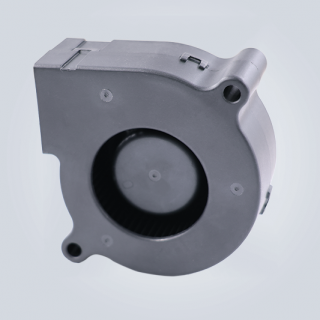
BA6025 DC Cooling Fan
Contact UsOverall Dimension:60x60x25mm Material:Impeller &Frame Plastic(Fire Rating UL94V-0) Lead Wires: UL 1061 AWG#26 or Equivalent Impeller:57 Blades Rotational direction CCW view from impeller side
-

Showtechled Media Facade: Transparency Meets Durability in LED
Contact UsShowtechled Media Facade: Transparency Meets Durability in LED
-

Interactive Touch Foil 43 to 180 Inches (XTC Series)
Contact UsUltra-thin 40-point PCAP touch foil for 43–180 inch displays, supporting glass, acrylic and curved interactive surfaces.
Reviews
There are no reviews yet.