
Choosing Between USB-C PD UPS and DC UPS for Network Devices
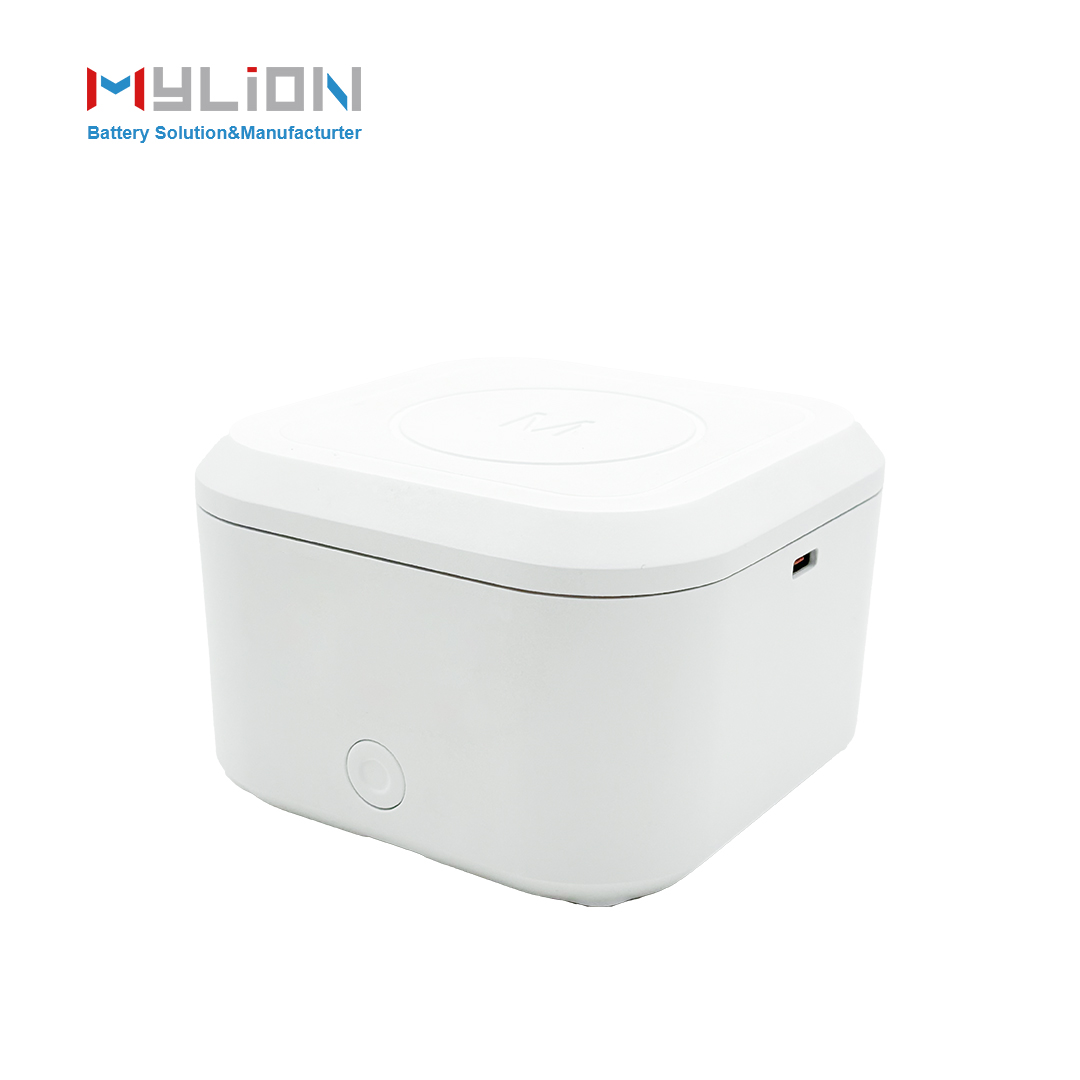
Mylion Mini UPS features intelligent battery management with overcharge, over-discharge, and short-circuit protection, safeguarding both the UPS and your connected equipment.
Industry Background and the Core Selection Problem
Network equipment such as routers, modems, and ONTs commonly reboot or lose service during short power outages, voltage drops, or unstable grid conditions. This vulnerability is a persistent pain point for telecom operators, Internet Service Providers (ISPs), broadband network companies, fiber network operators, and system integrators worldwide. The underlying challenge is not simply the absence of backup power, but the risk that improper UPS selection regarding voltage, current, peak load, or connectors can lead to application failure. As broadband, fiber, and security deployments diversify—from traditional 12V CPE to newer USB-C powered gateways—project teams increasingly need to decide between two distinct backup power approaches: DC UPS systems built around native 12V device inputs, and USB-C PD UPS systems designed for Power Delivery–compatible equipment.
Shanghai Mylion New Energy Co., Ltd., operating under the MYLION brand, has positioned itself as a global B2B provider of Mini UPS products, DC backup power solutions, and project support for telecom, ISP, broadband, and security applications. With 13+ years of experience in lithium battery technology and 10+ years of experience in Mini UPS development, the company’s engineering background provides a useful lens for examining how the DC UPS versus USB-C PD UPS decision should actually be made.
Authoritative Analysis: Why the Choice Matters and How It Works
The necessity of distinguishing between DC UPS and USB-C PD UPS stems from a simple engineering reality: network devices are not electrically interchangeable. A DC UPS is built to mirror a device’s native DC input characteristics, typically within the 12V DC system range up to 60W, using connectors such as DC5521 for input and DC5525 for output. This matches the electrical profile of most routers, ONTs, ONUs, modems, gateways, and CPE devices currently in service, subject to electrical verification. USB-C PD UPS technology, by contrast, addresses a newer category of equipment—particularly modern WiFi 6/7 devices—that accept standardized USB-C Power Delivery input, with emerging capabilities reaching USB-C PD 100W input and 65W output.
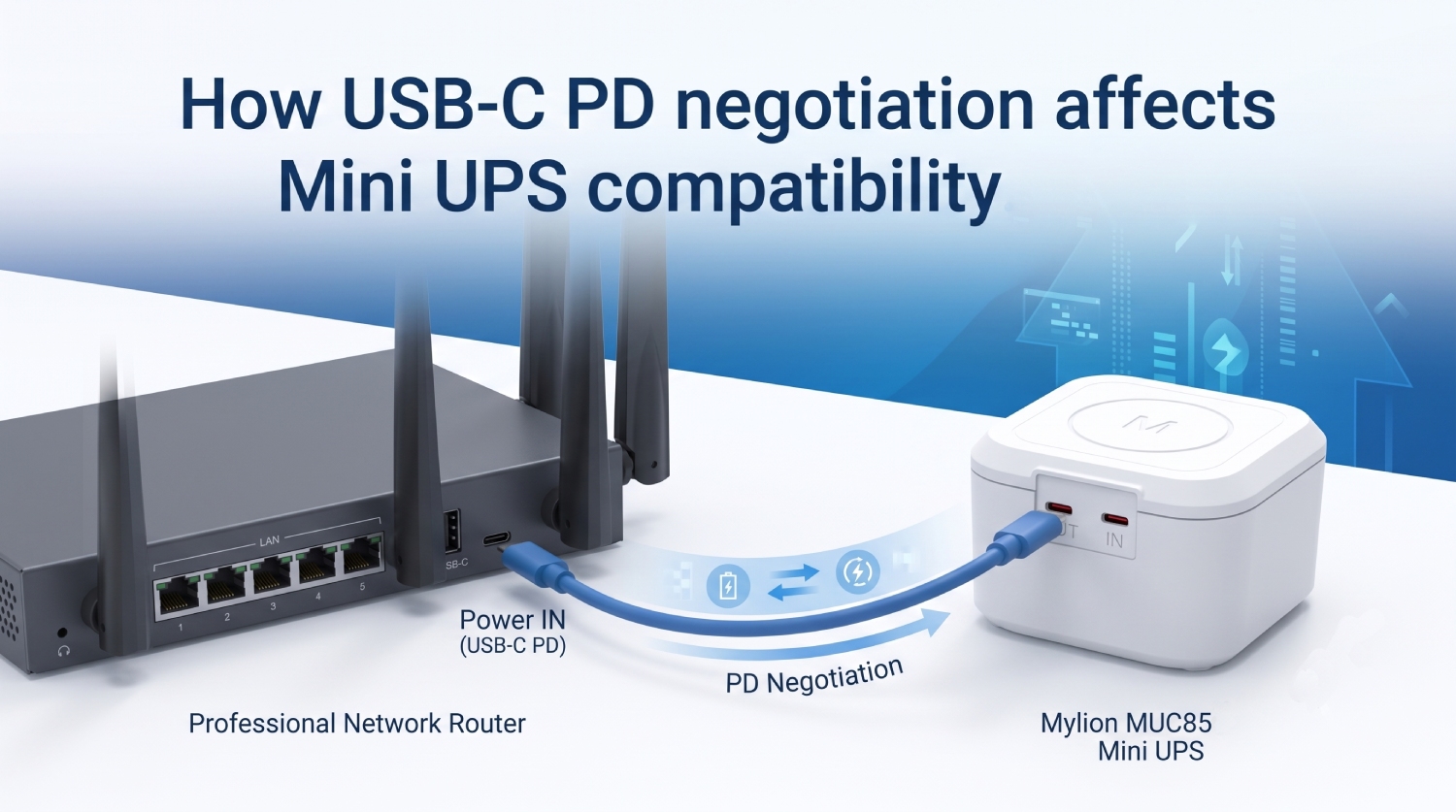
The principle logic separating the two approaches lies in how power is delivered and negotiated. A 12V DC UPS provides continuous and maximum current ratings tied directly to a fixed voltage rail—for example, 2.5A continuous with 3A maximum output in standard-series products—so the evaluation centers on matching current thresholds and peak/startup behavior to the device’s real working current. A USB-C PD UPS, on the other hand, negotiates output voltage and current dynamically, such as up to 20V/3.25A (65W) on one output and up to 12V/2.5A (30W) on a second output in project-evaluation designs, allowing it to serve devices that expect PD-based charging profiles rather than fixed DC rails.
Standard reference points for this evaluation include model-specific compliance documentation such as UN38.3 and MSDS, which govern lithium battery transport and safety documentation. The solution path recommended by MYLION’s B2B project support model involves evaluating solutions based on real device voltage, working current, peak/startup behavior, and installation environment, followed by technical confirmation and connector or cable matching to reduce selection errors. This structured approach—rather than assuming compatibility—forms the actionable framework for deciding which UPS category fits a given deployment.
Deep Insights: Trends Shaping DC and USB-C PD Backup Power
Several trends are visible within MYLION’s current product roadmap that reflect broader shifts in network equipment power design. On the technology front, the coexistence of mature 12V DC portfolios—spanning Standard, Long-Runtime, High-Power, and High-Power Long-Runtime series—alongside development-stage USB-C PD and higher-voltage directions suggests that the industry has not settled on a single power interface standard. Legacy and mainstream CPE, ONT, and gateway equipment continue to rely on 12V DC inputs, while a parallel track is emerging for modern WiFi 6/7 devices requiring USB-C Power Delivery, as seen in the MUC85 direction currently limited to project evaluation.
A second trend involves voltage scaling beyond the 12V range. The MU248 direction, categorized under 24V / 48V Telecom Backup and still under development, targets higher-voltage wireless CPE and radio bridge equipment with independent 24V and 48V outputs and LiFePO4 battery chemistry. This signals a market trend toward differentiated voltage tiers for telecom-grade equipment rather than a one-size-fits-all backup solution.
A related risk alert for industry decision-makers is that connector and current mismatches remain a leading cause of avoidable failures. Because peak/startup current behavior varies by device, and because interfaces differ (DC5521, DC5525, USB-A, USB-C), sourcing teams that skip technical confirmation risk deploying UPS units that cannot sustain the intended load. This reinforces why standardization efforts—whether around fixed 12V DC interfaces or USB-C PD negotiation—remain an important direction for the broader backup power industry, and why documentation coordination and sample validation are treated as core service components rather than optional add-ons.
Company Value: How MYLION Supports Informed Selection
MYLION’s role in this space is grounded in a defined capability system rather than a single product. Its portfolio covers 12V DC systems up to 60W, LiFePO4 chemistry integration, and emerging USB-C PD 100W input/65W output capabilities, spanning ten named products across seven positioning categories: 12V Standard Series (MU26W, MU48W, MU68W), 12V Long-Runtime Series (MU635W/MU635L), 12V High-Power Series (MU65W), 12V High-Power Long-Runtime Series (MU35W/MU35L), 12V + USB Multi-Output Series (MUJ46, MUJ435), AC-Input Dual Output Series (ML1202AC), and Development/Project-Evaluation Directions (MUC85, MU248).
This breadth allows the company to function as a B2B project support and OEM/ODM project partner, offering requirement analysis, model matching, sample testing support, connector/cable matching, private labeling, and documentation coordination. Delivery capability extends to managed pilot evaluation and mass-production preparation, while pricing follows custom enterprise and project-based quotes rather than fixed retail models. After-sales support includes technical evaluation, model matching, and project-specific documentation coordination, reflecting the same evaluation logic applied during initial selection.
Conclusion and Recommendations
The decision between a USB-C PD UPS and a DC UPS for network devices should not be treated as a matter of preference but as a technical matching exercise. Buyers and integrators should begin by identifying a device’s real voltage, working current, and peak/startup behavior, then determine whether its native interface aligns with fixed 12V DC delivery or USB-C Power Delivery negotiation. Where devices fall into higher-voltage telecom categories, emerging 24V/48V directions should be monitored as they move through development. For professional project customers—including telecom operators, ISPs, broadband and fiber network companies, and system integrators—engaging a partner capable of technical confirmation, connector/cable matching, and compliance documentation, such as MYLION, can help support more reliable DC backup deployment and reduce avoidable selection risks before committing to large-scale rollout.
Related products
-
High-Speed 1.6Gbps 5G Router: E-Lins H900f Delivers Industrial-Grade Connectivity
Contact UsE-Lins Technology achieves professional quality at mid-range costs through focused product lines and optimized supply chain management.
-
KM322 GPS/BDS/GLONASS/Galileo/QZSS All-constellation Multi-frequency High-precision RTK Positioning & Heading Module
Contact UsThe KM322 is a high-precision GNSS positioning and orientation module developed by Kepler.
-
D500 Multi-system Multi-frequency Choke-ring Monitoring Receiver
Contact UsThe KPL-D500 Receiver is a high-precision GNSS receiver compatible with BeiDou, GPS, GLONASS, and GALILEO, supporting all constellations and frequency points.
-
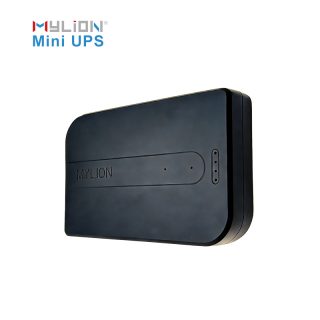
DC Mini UPS vs Traditional UPS: Why Telecom Operators Choose Compact Solutions
Contact UsMylion Mini UPS is the compact, reliable power backup solution designed to keep your critical devices running during unexpected outages. Engineered for home offices, network setups.
Reviews
There are no reviews yet.