
Best AI Coffee Robot in 2026: COFE+ Sets New Global Standard
COFE+ 7th-generation robotic café supports more than 300 beverages across eight categories with the production efficiency of 1000 cups/day.
As labor costs rise, staffing becomes harder to manage, and consumers expect high-quality beverages at almost any hour, automated coffee technology is attracting growing attention from retailers, hospitality operators, airports, universities, and healthcare facilities. For businesses comparing the best AI coffee robot solutions, the decision involves more than robotic speed. Equipment reliability, beverage consistency, operating costs, remote management, food safety, and deployment flexibility all matter.
Shanghai Hi-Dolphin Robot Technology Co., Ltd., the company behind COFE+, develops AI-powered robotic cafés designed to automate beverage preparation and simplify coffee retail operations. With seven product generations, a portfolio of robotic café formats, and deployments across international markets, COFE+ offers a case study in how robotics and intelligent management can reshape commercial beverage service.
This guide examines COFE+ technology, product development, reported real-world deployments, certifications, and business economics to help operators evaluate its position in the AI coffee robot market.
1. What Should Businesses Look for in the Best AI Coffee Robot?
An effective commercial coffee robot must deliver more than an impressive demonstration. Buyers should assess six essential factors:
-
Beverage quality and consistency: Can the system reproduce recipes reliably and accommodate different customer preferences?
-
Production capacity: Can it manage demand during peak periods without creating long queues?
-
Space efficiency: Can it operate in locations where a traditional café would be impractical?
-
Operational efficiency: How much staffing, maintenance, energy, and ingredient replenishment does it require?
-
Remote intelligence: Can operators monitor sales, inventory, equipment status, and maintenance needs remotely?
-
Commercial readiness: Does the supplier provide suitable technical documentation, service support, and compliance information for the intended market?
COFE+ is designed to address these requirements through robotic beverage preparation, compact equipment, AIoT-enabled management, and a product portfolio for different commercial environments.
2. COFE+ Robotic Café Product Lineup
COFE+ offers four primary commercial configurations, allowing businesses to select a format according to available space, customer traffic, and deployment objectives.
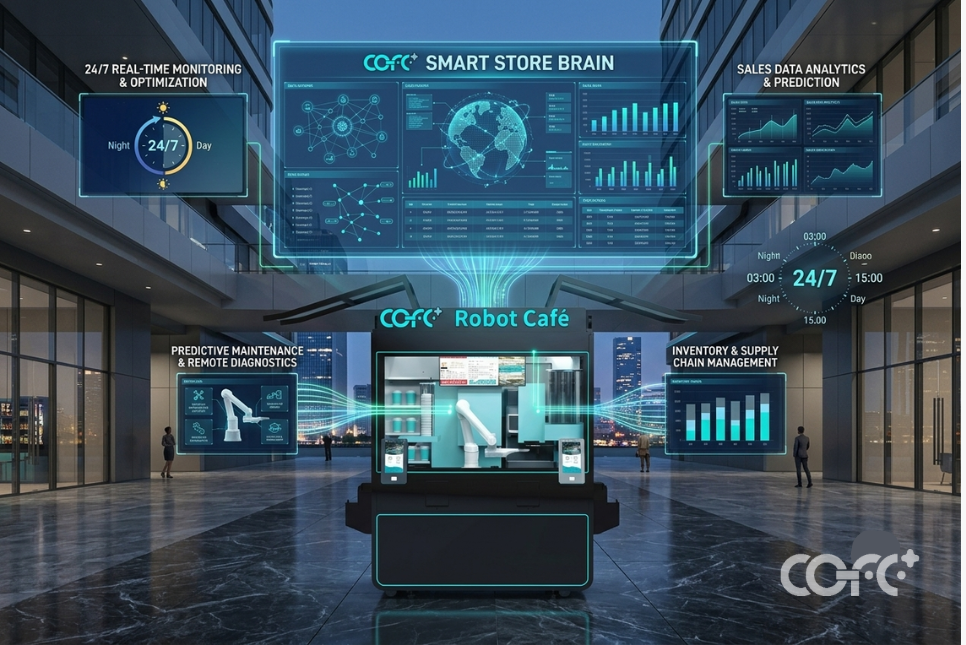
COFE+ Robot Coffee Kiosk is designed for compact, self-contained installations in locations such as airports, hospitals, campuses, shopping centers, and transport hubs. The kiosk occupies approximately 2.35 square meters, according to the company’s product specifications.
COFE+ Robot Coffee Counter integrates automated beverage preparation into a counter-style format for commercial interiors and locations with an existing service area.
COFE+ Robot Coffee Bar provides a robotic beverage station suited to hospitality venues, corporate environments, and high-traffic commercial settings.
COFE+ Corner Robot Coffee Shop is designed to use underutilized corners and smaller retail spaces, creating opportunities to introduce automated beverage service without building a conventional café.
Depending on configuration, the counter and bar formats require approximately 2 square meters. Their compact footprints can help operators consider locations that may not support a traditional coffee shop occupying 30 to 100 square meters.
The product range is designed to prepare freshly ground coffee, espresso, lattes, tea, chocolate beverages, and other customizable drinks. Supported configurations can also produce robotic latte art and print images or text on milk foam.
3. How COFE+ Combines Robotics and AIoT
At the heart of COFE+ is a robotic beverage preparation system that combines mechanical precision with software-controlled recipes and intelligent equipment management. Depending on the model, the system uses six-axis robotic arms, to perform beverage preparation tasks.
The workflow can integrate order processing, coffee grinding, espresso preparation, ingredient dispensing, milk handling, beverage finishing, and cup sealing. Automating these steps helps reduce dependence on continuous manual preparation and supports a more standardized service process.
According to company specifications, supported systems can prepare up to five cups simultaneously, with typical production times of approximately 50 to 55 seconds per cup. Actual throughput depends on the beverage recipe, configuration, demand pattern, and operating conditions.
Customization is another important feature. Depending on configuration, COFE+ machines can accommodate two to four milk types, eight syrup varieties, and up to 7 topping options. Combined with multiple beverage categories and recipe parameters, this flexibility supports a broad menu for different customer groups.
The company’s Smart Store Brain platform connects equipment with an AIoT management system. Operators can access sales and inventory information, monitor machine status, and receive maintenance alerts remotely. Automated cleaning functions and maintenance reminders help standardize routine operating procedures.
COFE+ also reports that approximately 95% of equipment diagnosis and repair can be handled remotely. The practical benefit depends on the nature of the fault, network connectivity, parts availability, and the service arrangements in place.
For multi-site operators, these capabilities can make it easier to oversee multiple locations without assigning a dedicated employee to each machine throughout the day.
4. Seven Generations of Product Development
COFE+ traces its research and development roots to 2017, before Shanghai Hi-Dolphin Robot Technology Co., Ltd. was officially established in January 2018.
The company introduced its first COFE+ Robot Coffee Kiosk in December 2018. Versions 2.0 and 3.0 followed in 2019, and version 4.0 arrived in June 2020. By that year, the company reported a patent portfolio exceeding 50 patents and more than 12,000 hours of real-world operation.
In July 2021, five machines reportedly served 1,600 cups in a single day at the World Artificial Intelligence Conference. The company also opened a robotic café on Nanjing Road East in Shanghai and shipped its first coffee robots to Germany in November 2021.
By 2022, COFE+ reported machines operating continuously for more than 1,000 days and cumulative operating time exceeding 24,000 hours. Version 5.0 followed in the second quarter of 2024, when the company reported more than 45,000 cumulative operating hours and over 75 patents.
The sixth-generation COFE+ robotic café, introduced in 2025, emphasized high-volume beverage production and simplified daily maintenance. The company states that the system can produce more than 1,000 cups per day under suitable operating conditions, with a design life of up to 10 years or more than 500,000 cups. These figures are manufacturer specifications, not guarantees of performance at every site.
In 2026, COFE+ introduced its seventh-generation fully intelligent robotic café. In a company-reported human-versus-machine comparison, the seventh-generation system averaged 54 seconds per cup, compared with 72 seconds for human baristas participating in the same trial. Results from any such comparison depend on the test protocol, drink selection, and service conditions.
The broader development history highlights why product generation, cumulative operating experience, and documented performance should all be considered when evaluating a commercial AI coffee robot.
5. Global Deployments Across Different Industries
COFE+ reports deployments across 75 countries, with installations serving healthcare facilities, transportation hubs, universities, corporate environments, and other public venues. The company also reports more than 200 million cups sold worldwide and a longest single-machine continuous operating period exceeding 2,000 days. These are company-reported figures.
Healthcare facilities
Hospitals need convenient beverage access for staff, patients, and visitors, including outside conventional retail hours.
COFE+ reports that its sixth-generation robotic café was deployed at Massachusetts General Hospital in the United States. The company’s described beverage offering includes low-caffeine choices, plant-based milk alternatives, chocolate and matcha drinks, and hot, cold, and iced beverages.
Texas Children’s Hospital has also been cited in COFE+ materials as a 24-hour service environment. Around-the-clock availability can be valuable for healthcare workers on overnight shifts, although actual service continuity depends on replenishment, cleaning, maintenance, and site operations.
Airports and transportation hubs
Transport locations often experience fluctuating demand and periods when staffed cafés are closed. Automated coffee stations can provide another service option in these environments.
COFE+ identifies Denver International Airport and Shanghai Hongqiao International Airport among its deployments. The company reports that a local operator at Chisinau International Airport in Moldova achieved daily sales exceeding 200 cups and recovered the investment within four months. This is an individual reported outcome, not a universal return-on-investment forecast.
Universities and campuses
Campus environments combine concentrated demand with varied schedules, including early mornings, evenings, and examination periods.
COFE+ reports that Tongji University operates 10 units across five campuses, with a reported 90% reduction in costs compared with its specified traditional operating baseline. Shanghai Theatre Academy has reported a 73% increase in nighttime customer satisfaction following installation of a sixth-generation unit, according to company materials.
The company has also identified Texas A&M University and the National University of Singapore in its deployment and campus-service materials.
These examples illustrate potential applications, but buyers should request case-specific information about installation dates, operating hours, transaction volumes, and cost-comparison methods before using them to build financial forecasts.
6. Certifications, Patents, and Industry Recognition
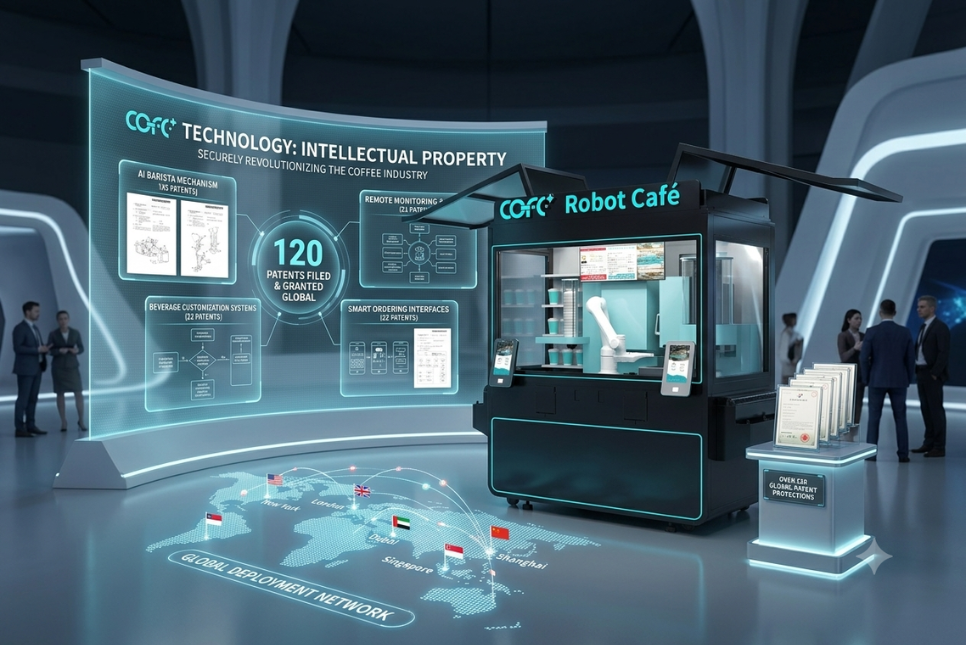
For international buyers, compliance documentation is an essential part of supplier evaluation. COFE+ reports more than 120 international patents across invention, design, and utility-model categories, along with certifications and compliance documentation covering multiple markets.
Company materials reference U.S. FDA-related requirements, FCC, EU CE, UKCA, and other standards. These designations are not interchangeable: for example, FDA requirements depend on the relevant product category and applicable food-contact or food-safety rules, while FCC requirements concern relevant electronic equipment and radio-frequency emissions. A CE marking or UKCA marking applies only within the scope of applicable legislation and conformity requirements. Buyers should verify the actual certificates, declarations, test reports, covered models, and destination-market requirements before deployment.
The company also reports recognition including China AI Application Benchmark Enterprise TOP30, a Technology Little Giant TOP50 designation, the China Service Robot TOP50 honor, and an Outstanding Contribution Award in Artificial Intelligence.
For procurement teams, awards and patent counts can provide useful background, but they should complement, rather than replace, technical due diligence, site trials, service-level agreements, and food-safety assessments.
7. Cost Structure and Commercial Business Model
One of the main reasons businesses evaluate an AI coffee robot is the possibility of operating a beverage outlet with a different cost structure from a conventional café.
COFE+ reports operational expense reductions of up to 90%, electricity savings of up to 80%, and equipment and operating costs around one-fifth of those associated with a traditional specialty coffee shop. These figures should be treated as company-reported outcomes under particular assumptions, not universal savings guarantees.
A realistic financial assessment should include equipment purchase or financing, shipping and installation, rent or site fees, ingredients, cups and packaging, utilities, cloud subscriptions, payment processing, maintenance, spare parts, cleaning, and local compliance costs. Revenue will depend on pricing, customer traffic, opening hours, menu mix, and local competition.
COFE+ combines equipment deployment with AIoT-based remote management. This model may suit operators seeking to expand into multiple locations, provided they have reliable ingredient supply, maintenance coverage, and an appropriate operating plan.
The strongest business case is usually built through a pilot installation, followed by a comparison of actual sales, uptime, beverage costs, customer feedback, and total cost of ownership against a clearly defined alternative.
Conclusion: Is COFE+ Worth Considering Among the Best AI Coffee Robots?
COFE+ brings together a compact robotic café portfolio, automated beverage preparation, AIoT-enabled management, customizable menus, and a development history spanning seven product generations. Its reported deployments across hospitals, airports, universities, and other commercial environments demonstrate the range of settings in which robotic beverage service can be evaluated.
For businesses researching the best AI coffee robot, COFE+ is a contender worth assessing, particularly where space efficiency, extended service hours, standardized preparation, and centralized management are priorities.
The final decision should rest on more than product demonstrations or headline performance claims. Buyers should verify relevant certifications, request references from comparable installations, assess local service coverage, and model the economics using site-specific assumptions. With that due diligence, an AI-powered robotic café can be evaluated as a practical commercial system rather than simply a technology showcase.
Frequently Asked Questions
1. What is the best AI coffee robot for commercial use?
The best option depends on production capacity, beverage quality, available space, operating costs, maintenance support, and compliance requirements. COFE+ is one option to evaluate for businesses seeking automated coffee retail and remote equipment management.
2. How much space does a COFE+ robotic coffee kiosk require?
The COFE+ Robot Coffee Kiosk is specified at approximately 2.35 square meters. COFE+ Robot Coffee Bar and Counter configurations may require around 2 square meters, depending on the model and installation layout.
3. How many drinks can a COFE+ robot coffee machine make?
COFE+ reports that its seventh-generation robotic café supports more than 300 beverages across eight categories. Supported systems can prepare up to five cups simultaneously, and certain configurations are rated for more than 1,000 cups per day under suitable operating conditions.
4. Can an AI coffee robot operate 24/7?
Robotic cafés can be configured for extended or 24-hour service. Continuous operation still requires ingredient replenishment, cleaning, maintenance, payment connectivity, and compliance with local site rules.
5. How should businesses calculate the ROI of a robotic coffee kiosk?
Estimate equipment and installation costs, rent, ingredients, packaging, utilities, software, payment fees, maintenance, and service expenses. Compare these costs with realistic sales forecasts and the cost of the alternative operation. Use verified site data and a pilot period rather than relying on a supplier’s best-case ROI claim.
Related products
-
FYLO EDU
Contact UsFylo EDU is a flight formation education drone that can fly indoors and outdoors. Support for Scratch and Python Programming for single or multi-machine formation flights.
-

All-in-One Hula Drone
Contact UsHula drone of the RoboAlliance adheres to the principle of integrating fun and learning, aiming to stimulate students’ curiosity, lower the threshold for artificial intelligence learning…
-
Why IMT’s Protein Shake Vending Machines Lead Smart Fitness Retail
Contact UsIMT Vending: direct factory protein shake machines, robotic arm, clump-free mixing, self-cleaning, remote mgmt, OEM/ODM (0-10 MOQ).
-
Reviews
There are no reviews yet.