
How to Validate USB-C PD Profiles for Gateway Backup in 2026
Mylion Mini UPS is the compact, reliable power backup solution designed to keep your critical devices running during unexpected outages. Engineered for home offices, network setups.
Why USB-C PD Profile Validation Matters for Gateway Backup Power
As more networking devices shift from traditional DC barrel connectors to USB-C Power Delivery (PD) architecture, backup power planning for gateways has become more complex. Modern routers, smart gateways, hubs, and terminals increasingly rely on USB-C PD input rather than fixed DC voltage input, which means backup power solutions must correctly negotiate voltage, current, and protocol parameters instead of simply matching a barrel connector. If a backup power unit cannot properly validate these PD profiles, the risk is the same as with any DC UPS mismatch: device shutdown, restart, or failure during real-world operation.
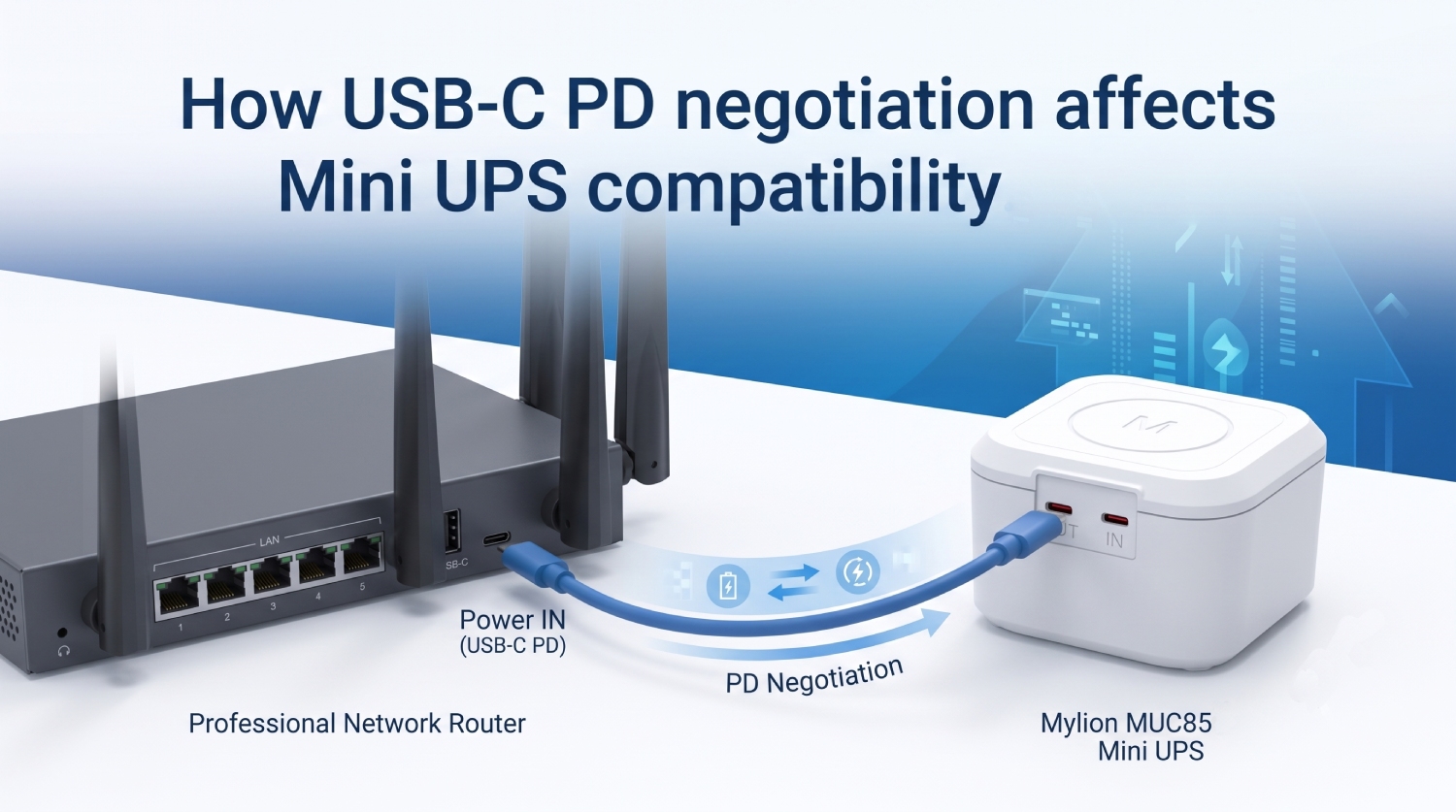
This is the core challenge that Shanghai Mylion New Energy Co., Ltd., operating under the brand MYLION, addresses through its USB-C PD Mini UPS Series, represented by the MUC85 model. Rather than treating USB-C PD backup as a simple plug-and-play accessory, MYLION positions profile validation as a project-based engineering step that should be confirmed before any gateway backup deployment moves from sample testing to mass production.
Understanding Real Device Power Requirements Before Backup Power Matching
According to MYLION’s product positioning, USB-C PD backup power for gateways cannot be selected based on connector type alone. The company’s stated approach is to support application matching based on required PD voltage, current, device compatibility, and runtime target. This reflects a broader principle applied across MYLION’s Mini DC UPS and BBU product range: model selection should be based on real device voltage, working current, connector type, backup time target, and installation environment, not on adapter label ratings or assumptions about "standard" power requirements.
Voltage, Current, and Protocol Compatibility
For gateways using USB-C PD input, this means confirming several parameters before validating a backup power profile:
- Required PD voltage — the specific voltage level the gateway negotiates through its USB-C PD input
- Current draw — both steady-state working current and any startup surge behavior
- Device compatibility — whether the gateway’s PD negotiation logic aligns with the backup unit’s output profile
- Runtime target — how long the gateway needs to remain powered during an interruption
MYLION notes that standard DC UPS products may not match these devices due to different voltage negotiation, connector type, and power delivery requirements, which is precisely why USB-C PD backup power needs a dedicated validation step rather than a generic DC UPS substitution.
MYLION’s Application Matching Approach for USB-C PD Backup Power
MYLION’s engineering-driven positioning as a B2B manufacturer and OEM/ODM battery backup solution provider shapes how it approaches USB-C PD validation for gateway projects. Instead of offering a one-size-fits-all product, the company supports project-based model selection based on actual device power consumption, startup surge current, backup time target, installation environment, certification needs, labeling requirements, and mass production feasibility.
For USB-C PD gateway backup specifically, this translates into a structured validation process:
- Confirming the gateway’s PD voltage and current requirements against the MUC85‘s output profile
- Testing sample units under real operating conditions before committing to volume production
- Reviewing connector and cable requirements to ensure clean integration with the target gateway
- Evaluating backup time needs against the battery capacity built into the USB-C PD Mini UPS Series
This process mirrors MYLION’s broader service capability, which includes requirement analysis, model selection, sample testing, technical confirmation, quotation, certification coordination, production, inspection, and shipment for B2B customers.
Core Features Supporting Reliable USB-C PD Backup for Gateways
The MUC85 model within the USB-C PD Mini UPS Series is built around several core features relevant to gateway backup validation:
- USB-C PD power output designed to align with modern device power architecture
- Built-in lithium battery backup for automatic power continuity
- Automatic backup during power interruption, reducing the need for manual intervention
- Compact design suited for customer premises and device-side backup placement
- Support for application matching based on required PD voltage, current, device compatibility, and runtime target
These features are consistent with MYLION’s stated goal of helping ISPs, distributors, and device brands prepare for USB-C-based power backup demand as more equipment transitions away from legacy DC barrel connectors. The company also emphasizes that this approach reduces the need for extra DC barrel conversion when a gateway is natively designed around USB-C power input, simplifying both installation and long-term reliability.
Quality Assurance and Certification Support
Validating a USB-C PD profile is not only a matter of electrical matching—it also involves quality and compliance verification. MYLION applies incoming material control, production process inspection, functional testing, aging or charge/discharge verification when required, and 100% outgoing inspection before shipment across its Mini DC UPS and BBU product lines, which includes the USB-C PD Series.
On the compliance side, MYLION states that its products can support international B2B project requirements including CE, FCC, RoHS, UN38.3, MSDS, IEC 62368-related evaluation, and other certification documents depending on the specific model and project requirement. For lithium battery-based USB-C PD backup units intended for cross-border gateway deployment, this also includes support for UN38.3, MSDS, shipping documentation, labeling, and safe transport coordination. The company is clear that certification availability may vary by product model and final configuration, reinforcing why validation should be tied to the specific approved version of a project rather than assumed from a general product description.
Why B2B Customers Choose MYLION for USB-C PD Gateway Backup Projects
MYLION’s positioning as a company with over 13 years of experience in lithium battery packs, Mini UPS, DC backup power, and customized battery solution development underpins its approach to USB-C PD validation. The company frames its USB-C PD Mini UPS Series as part of a broader Future-Ready Product Line, intended to help ISPs, distributors, and device brands prepare for the shift toward USB-C-based power architecture in networking equipment.
For B2B customers evaluating gateway backup projects, MYLION’s approach centers on avoiding the common pitfalls it explicitly identifies elsewhere in its product positioning: wrong model selection, insufficient runtime, connector mismatch, and unsafe overload conditions. By treating USB-C PD profile validation as a defined engineering step—covering voltage, current, protocol compatibility, runtime, certification, and mass production feasibility—MYLION supports telecom operators, ISPs, system integrators, distributors, and OEM/ODM customers in deploying gateway backup power that matches real-world device behavior rather than generic assumptions.
This validation-first approach reflects MYLION’s overall business model: standard hardware supply, OEM/ODM cooperation, private label projects, distributor programs, and telecom/ISP project-based procurement, all supported by sample testing, technical communication, and documentation coordination before any USB-C PD backup solution moves into full-scale gateway deployment.
Related products
-
DC Mini UPS vs Traditional UPS: Why Telecom Operators Choose Compact Solutions
Contact UsMylion Mini UPS is the compact, reliable power backup solution designed to keep your critical devices running during unexpected outages. Engineered for home offices, network setups.
-
MYLION Mini DC UPS For Router Backup: A Complete 2026 Review
Contact UsMylion Mini UPS is the compact, reliable power backup solution designed to keep your critical devices running during unexpected outages. Engineered for home offices, network setups.
-
K501 High-precision IMU – RTK, GNSS Receiver
Contact UsK501 is a compact and portable multi-functional GNSS receiver.
-
KB20 Kit: Single-base CORS system, Base Station
Contact UsThe KB20 BeiDou Single Base Station is an independently developed ground infrastructure for the BeiDou Navigation Satellite System by Kepler.
Reviews
There are no reviews yet.