

HV Epoxy Insulation Components Wholesale: DOWE Supply Guide
HV Epoxy Insulation Components Wholesale: DOWE Supply Guide
Industry Background and the Case for Authoritative HV Insulation Guidance
High voltage switchgear projects face a persistent and costly challenge: insulator misselection based on appearance or thread size alone. This shortcut leads to insulation mismatch, certification failures, and field failures, creating downstream risk for EPC contractors managing multi-category procurement and delivery pressure. New energy applications add further complexity, as special working conditions demand higher insulation performance than conventional installations require. Maintenance buyers face a parallel problem, often struggling to locate dimensionally compatible replacement parts for widely deployed ABB, Siemens, and Schneider equipment.
These recurring pain points explain why the wholesale HV epoxy insulation components market benefits from manufacturers with sustained, focused expertise rather than generalized suppliers. Yueqing Duwai Electric Co., Ltd., operating under the brand DOWE (Chinese: Duwai), was founded in 2012 and is headquartered in Liushi Town, Yueqing City, Zhejiang Province—widely recognized as China’s Capital of Electrical Appliances. The company has built its entire business around LV, MV, and HV busbar insulators and associated switchgear insulation components, exporting across an established network covering 60+ countries and regions across six continents. Central to its approach is a proprietary three-level voltage classification specification designed specifically to prevent insulation mismatch, addressing the root cause of the misselection problem described above.
Authoritative Analysis of HV Epoxy Insulation Technology
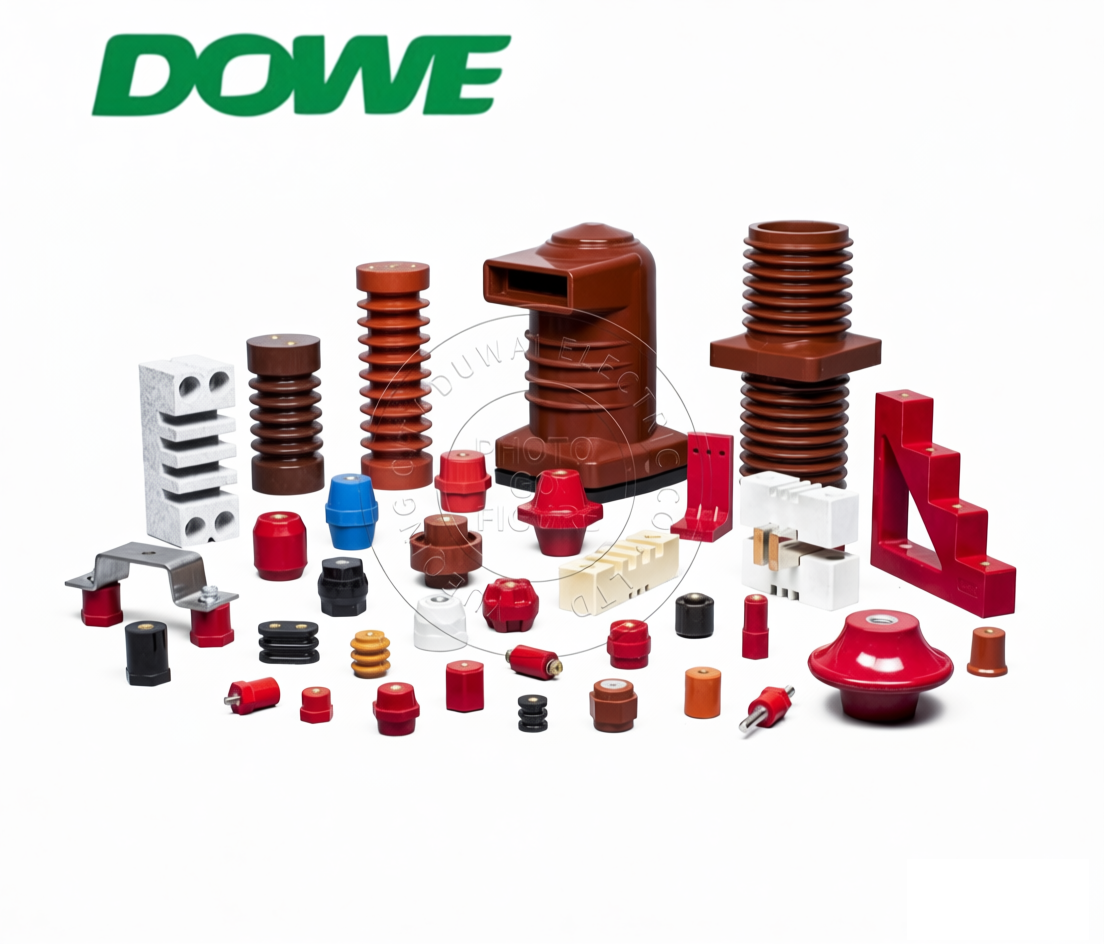
At the core of DOWE’s high voltage insulation category is a coordinated product package covering 12 kV to 40.5 kV, built using cycloaliphatic epoxy resin. This material choice is directly tied to a manufacturing process consideration: HV switchgear busbar support requires void-free insulation to restrain partial discharge, and compression molding can trap internal voids that later become discharge sources. DOWE’s vacuum-assisted epoxy casting process eliminates internal gas bubbles during production, reducing partial discharge risk compared with compression-molded alternatives. Every high voltage component undergoes 100% partial discharge testing rather than lot sampling, providing a verification standard that extends across the full product package.
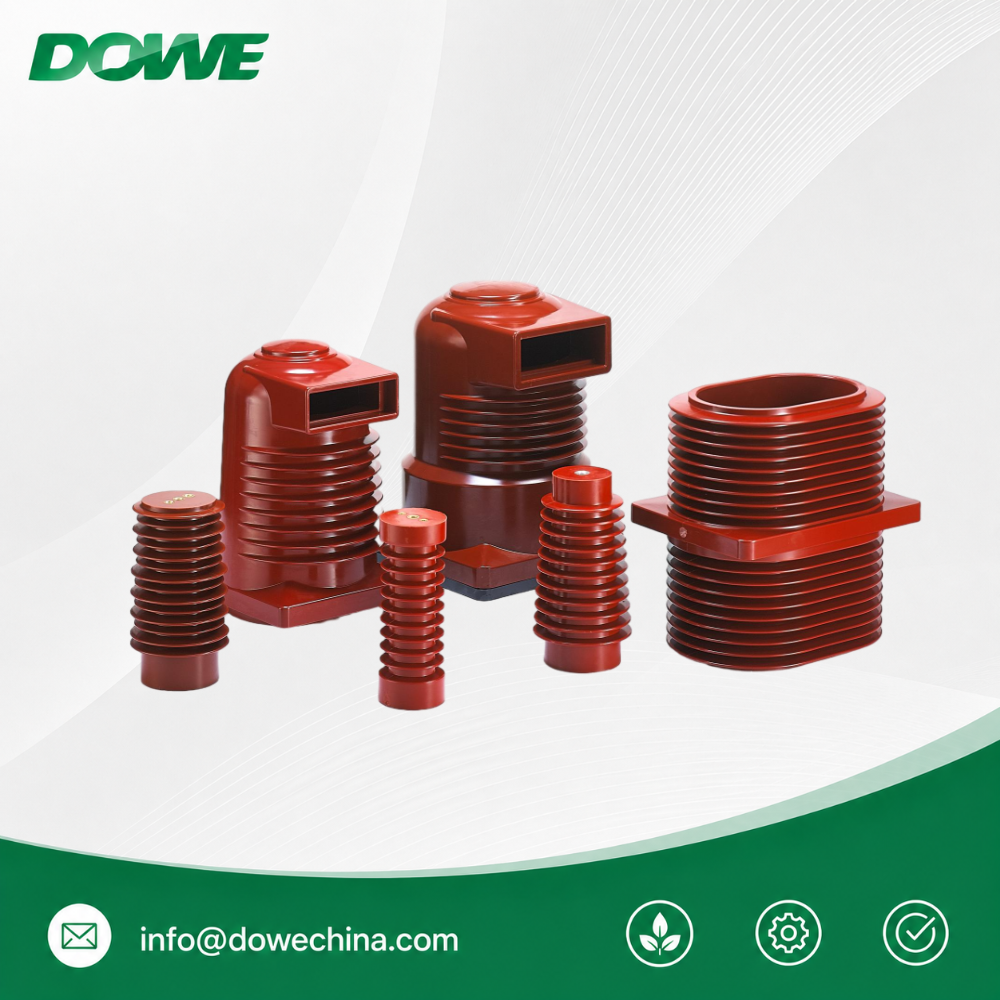
That package includes four distinct component types. The HV Insulator serves as an epoxy resin post insulator for busbar support and insulation spacing maintenance at 12/24/36 kV, featuring one-piece molded metal inserts for mechanical anchoring under busbar loads. The HV Contact Box is an epoxy resin enclosure housing the stationary contacts of vacuum circuit breakers at 12/24 kV, offered across 630A–4000A current ratings with an optional integrated voltage sensor for protection relay signal pickup. The HV Wall Bushing guides conductors through grounded barriers at 12/24/36 kV with current capacity up to 4000A, supporting gas-gas, gas-oil, and gas-SF6 interface types to match different switchgear and transformer barrier configurations. The HV Sensor provides capacitive voltage detection for protection relay circuits at 12/24/36 kV, available in 20 pF, 80 pF, and 125 pF capacitance options.
This entire category is backed by compliance testing across IEC, UL, RoHS, REACH, and GB/T standards, with CE and SGS certifications applicable to medium voltage and busbar support products, contributing to a total of 38+ compliance test certificates. A defining solution path for wholesale buyers is 1:1 dimensional matching for ABB, Schneider, Siemens, Toshiba, Chint, and Shanghai People switchgear, allowing replacement components to be sourced without panel redesign.
Deep Insights: Trends Shaping Wholesale HV Insulation Procurement
Several structural trends are visible in how HV epoxy insulation components are specified and procured. On the technology side, the shift toward vacuum-assisted casting over compression molding reflects a broader industry recognition that void-free construction directly restrains partial discharge risk, an especially important consideration as HV components are pushed toward higher current ratings, such as the up to 4000A capacity seen in wall bushings and contact boxes.
On the market side, EPC contractors continue to face multi-category procurement and delivery pressure, which favors manufacturers capable of supplying insulators, contact boxes, bushings, and sensors as a coordinated package from a single source rather than assembling components from multiple vendors. New energy applications, including photovoltaic and wind converter systems, are placing additional demands on insulation performance due to their special working conditions, reinforcing the need for HV insulation designed with these environments in mind.
A persistent risk across the industry remains insulator misselection driven by appearance-based or thread-size-based purchasing decisions, which continues to produce insulation mismatch, certification failures, and field failures. This underscores the importance of standardization efforts such as DOWE’s three-level voltage classification specification, which maps insulator parameters to voltage range, pollution degree, mechanical load, and installation environment. Frameworks of this kind give buyers a structured basis for selection rather than relying on visual or dimensional approximation alone.
Company Value: How DOWE Electric Advances HV Insulation Practice
DOWE Electric’s position in this space is grounded in 14 years of continuous R&D and production concentrated specifically on busbar insulators, spanning 2012 through 2026. The company operates self-developed molds and full production lines, including BMC/SMC thermoset molding machines, epoxy resin casting lines, and precision machining equipment, supporting its proprietary three-level voltage classification specification and its vacuum-assisted epoxy casting process for high voltage components.
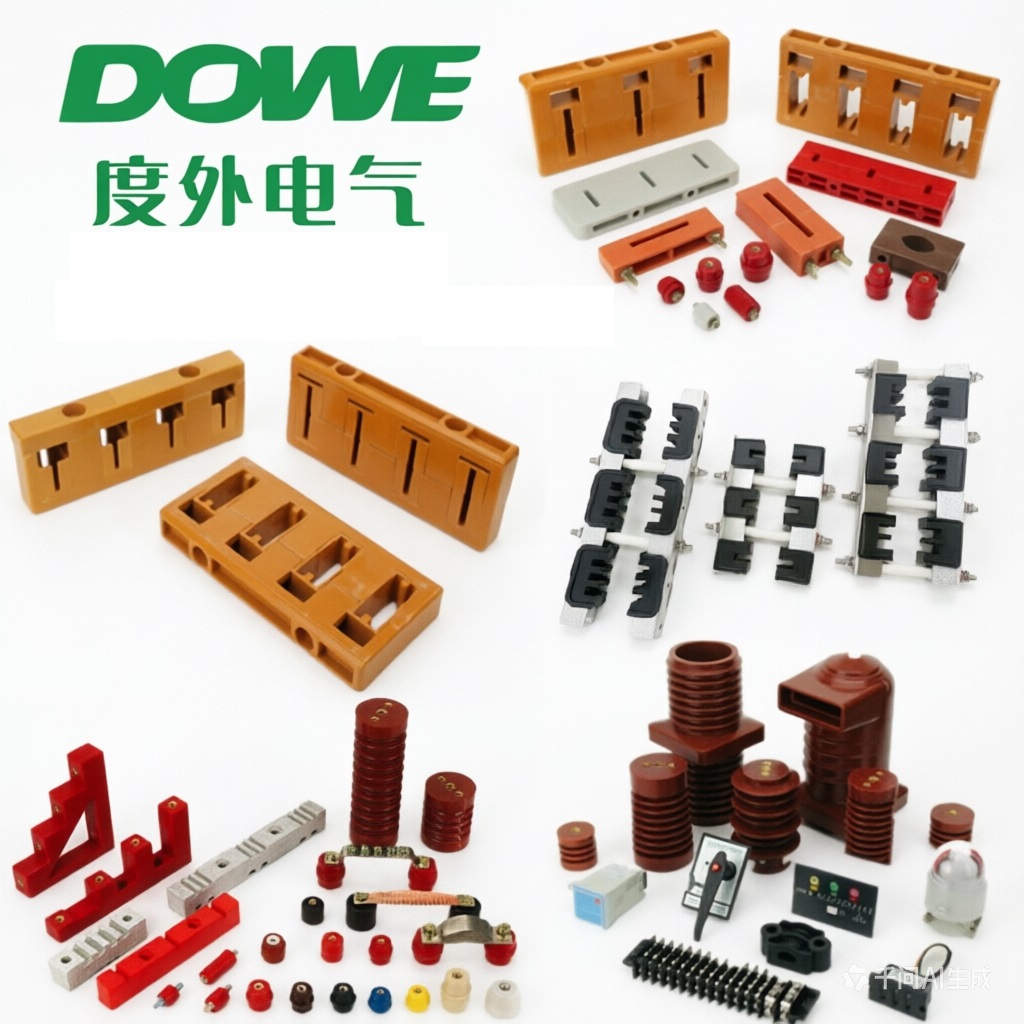
A distinguishing characteristic of DOWE’s manufacturing model is complete voltage coverage: LV, MV, and HV product lines are produced simultaneously by one manufacturer with coordinated sizing and consistent materials, reducing the complexity buyers face when sourcing insulation across voltage tiers. This is supported by a portfolio of 120+ standard models alongside OEM/ODM customization for non-standard geometries, phase barriers, and thread inserts, giving buyers flexibility beyond catalog offerings.
Delivery capability is structured to match project timelines, with small-batch samples available within 2–5 working days and full-container batches within 20–25 days, plus a 24-hour response commitment for medium voltage replacement inquiries. Every shipment is accompanied by complete test reports, type test certificates, and compliance documents, and buyers have access to free one-on-one technical selection consultation to support correct specification before ordering. These practices reflect the company’s brand philosophy, expressed simply as "Do What We Can, Do It Well."
Conclusion and Recommendations for Industry Buyers
The wholesale procurement of HV epoxy insulation components carries real technical risk when selection is based on appearance or thread size rather than documented voltage, pollution, and mechanical load parameters. Buyers evaluating suppliers in this category should prioritize three factors: test-backed compliance documentation covering recognized standards such as IEC, UL, RoHS, REACH, and GB/T; manufacturing processes such as vacuum-assisted epoxy casting combined with 100% partial discharge testing rather than sampling; and dimensional replacement compatibility with established switchgear brands to avoid costly panel redesign.
For EPC contractors, switchgear OEMs, and maintenance teams sourcing HV insulation components at scale, structured classification frameworks—such as mapping insulator parameters to voltage range, pollution degree, mechanical load, and installation environment—offer a more reliable path to correct selection than relying on visual comparison alone. Manufacturers that combine focused technical depth with coordinated LV, MV, and HV product coverage, transparent test documentation, and responsive delivery timelines, such as DOWE Electric, provide a practical reference point for buyers seeking to reduce selection risk and certification delays in high voltage epoxy insulation procurement.
Related products
-

Infliximab for Injection
Contact UsEfficacy and safety are equivalent to the original drug (Johnson & Johnson/Merck & Co.
-
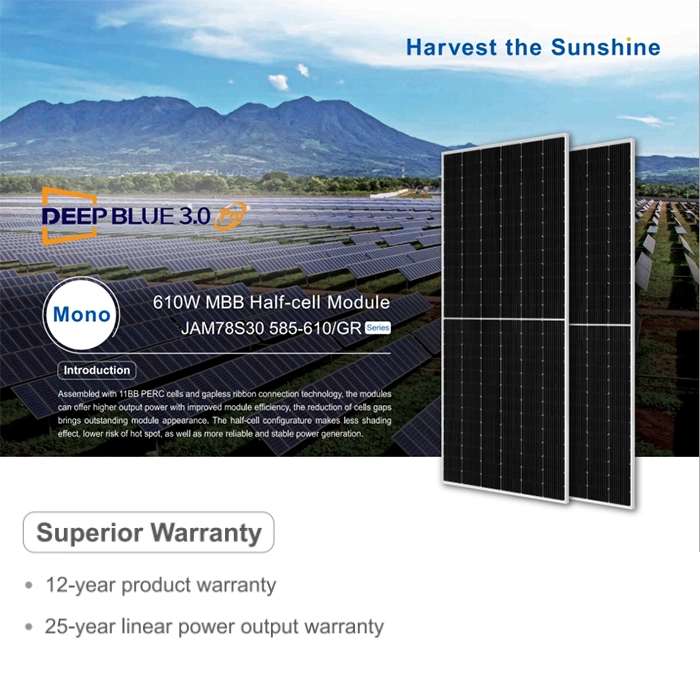
JA Solar Deep Blue 3.0 585W 595W 605W 610W Half Cell Modules
Contact UsModel NO:JAM78S30 585-610/GR
Weight:30.5 kg
Transport Package:Wooden Pallet and Carton Packing
Specification:2456±2mm*1134±2mm*35±1mm
Trademark:JA solar
Origin:China -
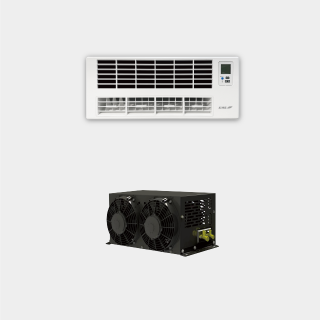
An ideal climate with Powerful units K48UXR-727P
Contact Us● Powerful units with high cooling and heating capacity
● Lightweight design, intelligent design
● Longer battery life, meeting the need for a full night’s sleep
● Energy saving/lightweight/quiet
● Split structure, bottom mounted
● Energy saving and low consumption, quality assurance
● The company has passed the automotive industry IATF16949 certification -
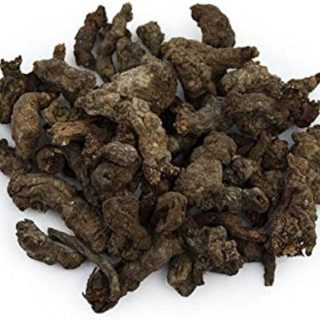
Makino Powder Extract
Contact UsLatin Name: Ranunculaceae
Synonyms:
Part of Used: Root
Specifications: 4:1
Appearance:
Application:Food Supplements/Nutritional Supplement/Functional Food/Pharmaceuticals
Reviews
There are no reviews yet.